
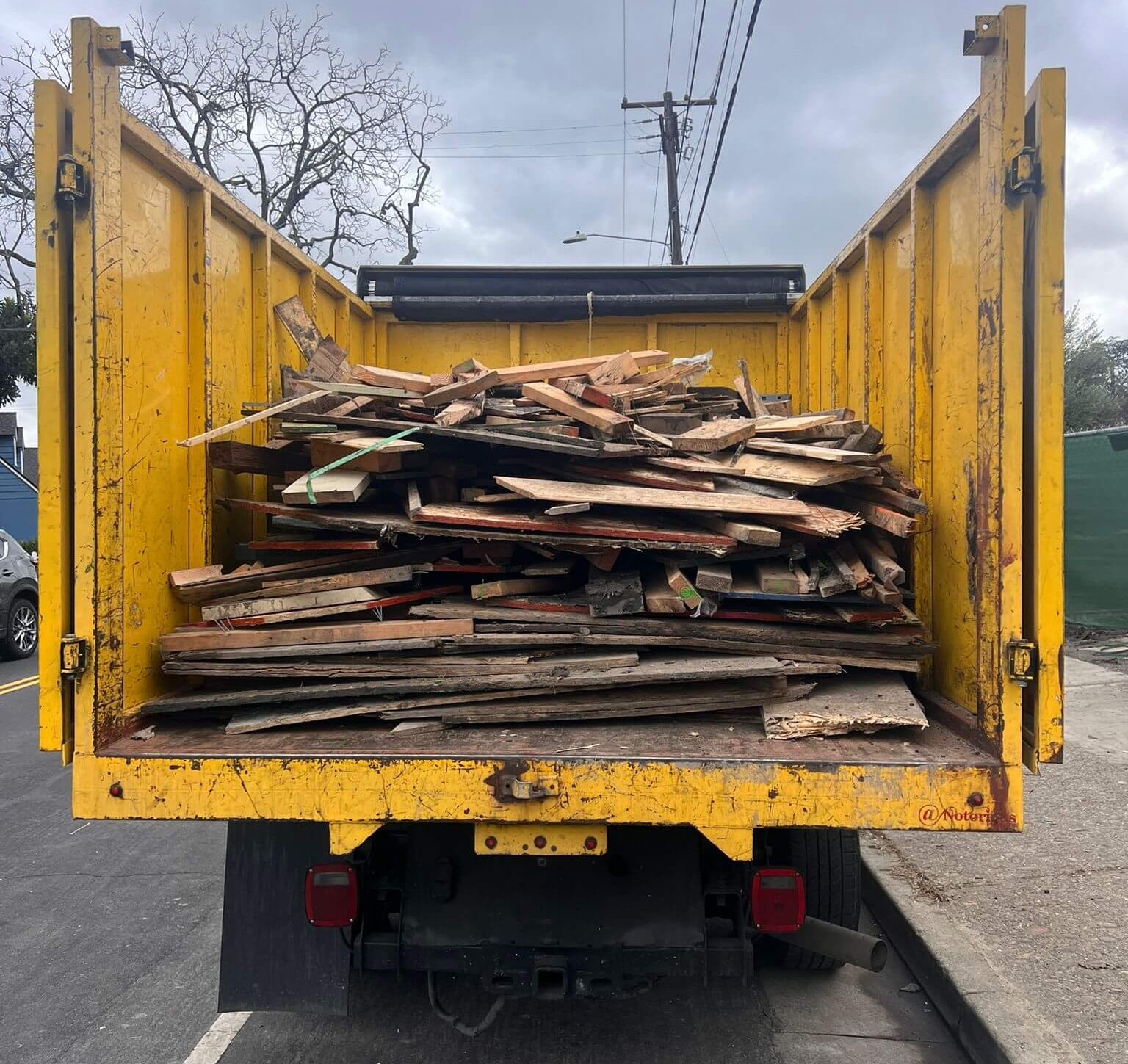
Key takeaways
- Construction cleanup is three distinct phases, not one job. Rough clean during the build, final clean before handover, touch-up clean after the punch list. Each has different scope and different people doing it.
- Debris removal and janitorial cleaning are different trades. We clear material. A cleaning contractor cleans surfaces. Most jobs need both and most quotes confuse them.
- The rough clean phase is where the money is saved. Debris cleared as each trade finishes costs less than one clearance at the end, and the saving shows up in trade productivity rather than the disposal invoice.
- Cleanup is priced on volume, weight, access and labour, with weight dominating on anything involving concrete, tile or soil.
- Separating streams on site changes the rate on the whole load. Mixed construction debris is the most expensive category at any facility.
- On an occupied or multi tenant building the schedule is set by the building’s permitted hours and the freight elevator, not by how much there is to move.
The short answer
A construction clean happens in three phases. The rough clean runs during the build and removes debris as each trade finishes. The final clean happens once construction is complete and prepares the space for handover. The touch-up clean follows the punch list. Debris removal spans all three phases and is what we do. The detailed surface cleaning in the final phase is a janitorial contractor’s scope. Knowing which one you are buying is the difference between an accurate quote and a surprise.
What the three phases actually cover
The trade uses this vocabulary consistently and it is worth using it when you ask for a quote, because it tells the contractor exactly what you need.
| Phase | When | What it covers | Who does it |
|---|---|---|---|
| Rough clean | During construction, after each trade phase | Debris, offcuts, packaging and waste removed. Floors swept. Egress routes and work areas cleared | Debris removal crew, sometimes the trades themselves |
| Final clean | After construction, before handover | Remaining debris out, then detailed cleaning of surfaces, fixtures, glass and floors | Debris removal crew, then a janitorial contractor |
| Touch-up clean | After the punch list is worked through | Debris from remedial work removed, affected areas re cleaned | Both, usually in small visits |
The mistake that causes the most friction is treating this as one line item on a schedule of works. A single construction cleanup line, priced once and scheduled at the end, guarantees that the rough clean never happens, which means the site runs dirty for the whole build and the final clearance is far larger than it needed to be.
Where debris removal ends and cleaning begins
This is the part worth being completely clear about, because it decides who you should be calling.
Construction debris removal means material leaving the building. Offcuts, packaging, strip out material, broken fixtures, pallets, drywall, timber, metal, concrete, tile and the general accumulation of a build. It is measured in volume and weight, it goes in trucks, and it is priced by how much there is and how hard it is to get out.
Construction cleaning means surfaces becoming clean. Dust removal from every horizontal surface, cleaning glass and frames, wiping down fixtures and fittings, cleaning inside cabinets, polishing or sealing floors, cleaning restrooms to an occupancy standard. It is measured in square footage, it needs cleaning equipment and chemicals, and it is a different trade with different insurance.
| Task | Debris removal | Janitorial cleaning |
|---|---|---|
| Clearing offcuts, packaging and demolition material | Yes | No |
| Sweeping and shovelling out bulk debris | Yes | No |
| Removing pallets, crates and site rubbish | Yes | No |
| Hauling heavy material by weight | Yes | No |
| Fine dust removal from surfaces and ledges | No | Yes |
| Glass, frames and track cleaning | No | Yes |
| Floor polishing, sealing and buffing | No | Yes |
| Restroom and kitchen cleaning to occupancy standard | No | Yes |
We do the left column. We do not do the right column, and we will tell you so rather than taking the job and subcontracting it badly. On most projects the sequence is that we clear the material out, then the cleaning contractor comes in behind us, because cleaning a space that still has debris in it is wasted work.
Scheduling cleanup into the build
The rough clean phase is the one with the largest effect on what a project costs, and it is the one most often skipped.
Letting debris accumulate for a single clearance at the end looks like a saving on paper. In practice the disposal cost barely changes, because the same material leaves the building either way. What changes is everything else.
- Every trade working around a debris pile works slower. On a job with trades in sequence that compounds across the whole programme.
- Material gets moved out of the way rather than out of the building, then moved again later. That is labour paid twice.
- Streams get mixed. A pile that sits through three trades is mixed debris regardless of how it started, and mixed debris is the highest rate available.
- Material left outside absorbs water. Gypsum, timber and insulation all get materially heavier for it, and disposal is by weight.
- Blocked egress, accumulated combustible material and debris on stairs are what gets written up on a site walk.
- One large clearance at the end is a single mobilisation landing exactly when the programme has the least slack.
The useful clearance points are the trade handovers rather than fixed dates: after demolition and strip out, after framing and rough in, after drywall, after flooring and finishes, before any inspection, and a final clear before handover. Construction site cleanup for contractors covers how that is set up as a standing arrangement rather than a series of reactive calls.
How construction cleanup is priced
Debris removal prices on four things, and two of them are within your control.
| Factor | Effect | Can you influence it |
|---|---|---|
| Weight | Dominant on anything with concrete, tile, soil or roofing | Yes. Keep heavy streams separate and keep piles covered from rain |
| Volume | Dominant on packaging, insulation and light framing waste | Yes. Clearing in passes stops volume accumulating and compacting |
| Access | Large. Dock, elevator, stairs, carry distance, parking | Rarely, but booking the dock and elevator in advance saves real time |
| Labour | Driven by access and by how ready the material is to load | Yes. Staged material loads far faster than material spread across a floor |
The single largest controllable saving is separating debris on site. Clean concrete goes to aggregate recycling, clean soil has a cheap route and is sometimes taken free, scrap metal returns value, clean timber and cardboard both price below mixed waste. A mixed pile has none of those routes and prices at the top rate on the entire volume. It costs a few minutes of crew discipline from the first day, because nobody sorts a mixed pile afterwards.
We quote per visit or per job after seeing the site, and confirm a firm figure on site before loading. We do not publish per square foot rates, because debris removal is not a square footage service and a figure like that would mislead you.
Heavy material and why it prices differently
Concrete, tile, masonry, soil and roofing behave differently from everything else on a site and they are worth handling separately.
- They reach a container’s weight limit long before they fill it, which is how overweight charges and rejected containers happen.
- Wet material weighs substantially more. Covering an excavated or demolished pile between the work and the collection is among the cheapest savings available and almost nobody does it.
- Mixing them with light debris means the whole load prices as mixed, losing both the aggregate route and the clean fill route.
- Rebar in concrete slows break up and some recyclers want the steel separated, though it carries scrap value in return. Concrete removal prices considerably better when the concrete is clean of soil.
- A pickup bed of concrete or soil exceeds the payload of most trucks while still looking half empty.
Occupied and commercial buildings
On a tenant improvement or a refit inside a working building, the constraints come from the building rather than the drawings.
- Permitted hours. Many buildings restrict debris movement to outside business hours, which can mean evenings and weekends only.
- Freight elevator. Usually shared, often needing reservation and protective padding, and frequently the bottleneck on the whole programme.
- Loading dock. Shared and time limited, sometimes booked per load rather than per day.
- Common area protection. Corridors, lobbies and elevator interiors need protecting, and damage to them is charged back.
- Certificate of insurance. Building management will usually require one naming the owner and management company before any vendor reaches the dock, and that applies to your hauler as much as your electrician.
- The building’s own compactor normally cannot be used for construction debris, so every load leaves by truck.
Tenant improvement debris work is where these constraints bite hardest, and they decide the schedule far more than the quantity of material does.
What stops a load being accepted
A rejected or downgraded load costs the tipping fee, the haul and the time, so it is worth knowing the causes.
- Hazardous material in any quantity. Paint, solvents, adhesives and sealant tubes are the usual culprits.
- Gypsum mixed into a load bound for a facility that requires drywall separated.
- Soil mixed into clean concrete, or concrete mixed into clean soil. Each downgrades the other.
- Electronics and fluorescent tubes, both regulated in California and both routinely swept up with ceiling debris.
- Liquids of any kind, including part filled containers and anything that has collected rainwater.
- Material from a pre 1980s building where asbestos has not been ruled out. That stops the load and should stop the work.
On an older building the testing happens before the strip out, not after a load is turned away. Suspended ceilings, floor tile and mastic, pipe insulation, textured coatings and drywall joint compound are the usual locations, and a positive result means a licensed abatement contractor rather than a demolition crew.
Site housekeeping and inspections
Cleanliness on a construction site is a compliance matter before it is an aesthetic one, and the items that get written up are consistent: blocked or obstructed egress, accumulated combustible material, trip hazards in walkways, debris on stairs and landings, uncovered containers, and material stacked against electrical panels or fire equipment.
None of those are about tidiness. They are about what happens if the site has to be evacuated or a fire starts. A site cleared in passes rarely presents them. A site cleared once at the end presents all of them for most of the programme.
How TheTopJunk handles construction cleanup
- Debris removal across all three phases, scheduled to your trade handovers rather than as reactive calls.
- Streams separated as loaded, with scrap credited and clean concrete, soil, timber and cardboard routed to their own rates.
- Certificates of insurance issued to the building owner, management company or general contractor before the first load.
- Crews working to site induction, sign in and site rules.
- Weight tickets with a stream breakdown where you need them for a client or a diversion report.
- An honest flag on anything needing testing before the work proceeds, and a firm price confirmed on site.
We work across Campbell and the South Bay, on single jobs and standing arrangements. For the detailed final clean we will tell you plainly that you need a cleaning contractor, and we will schedule our clearance so they are not working around our material.
Frequently asked questions
What are the three phases of construction cleanup?
Rough clean during the build after each trade phase, final clean once construction is complete and before handover, and touch-up clean after the punch list. Debris removal spans all three. The detailed surface cleaning in the final phase is a janitorial scope.
Is construction cleanup the same as construction cleaning?
No, and conflating them is the most common source of a wrong quote. Debris removal means material leaving the building, priced by volume and weight. Cleaning means surfaces becoming clean, priced by square footage. Most projects need both, in that order.
Do you do the final janitorial clean?
No. We clear the material and a cleaning contractor cleans the surfaces. We would rather tell you that than take the job and subcontract it badly. We will schedule our clearance so the cleaners are not working around debris.
Is it cheaper to clear debris once at the end?
Almost never. The disposal cost is similar because the same material leaves either way, but trade productivity drops, material gets double handled, streams get mixed and price at the top rate, and material left outside gains weight from rain.
How is construction cleanup priced?
On weight, volume, access and labour, quoted per visit or per job after seeing the site. We do not publish per square foot rates, because debris removal is not a square footage service and such a figure would mislead you.
Why does separating debris matter if it all leaves in a truck?
Because mixed construction debris is the highest disposal rate at any facility. Clean concrete, soil, metal, timber and cardboard each price lower and the metal returns value. Nobody sorts a mixed pile later, so separation has to start on day one.
Planning cleanup on a build?
Decide which phases you need, keep the streams separate from the first day, and book the clearance points against your trade handovers rather than the completion date. Those three decisions do more for the cost of a project than negotiating the haul rate.
Call TheTopJunk for construction cleanup across Campbell and the South Bay. Debris removal through every phase of the build, streams separated and credited, insured and inducted crews, and a firm price confirmed on site.