
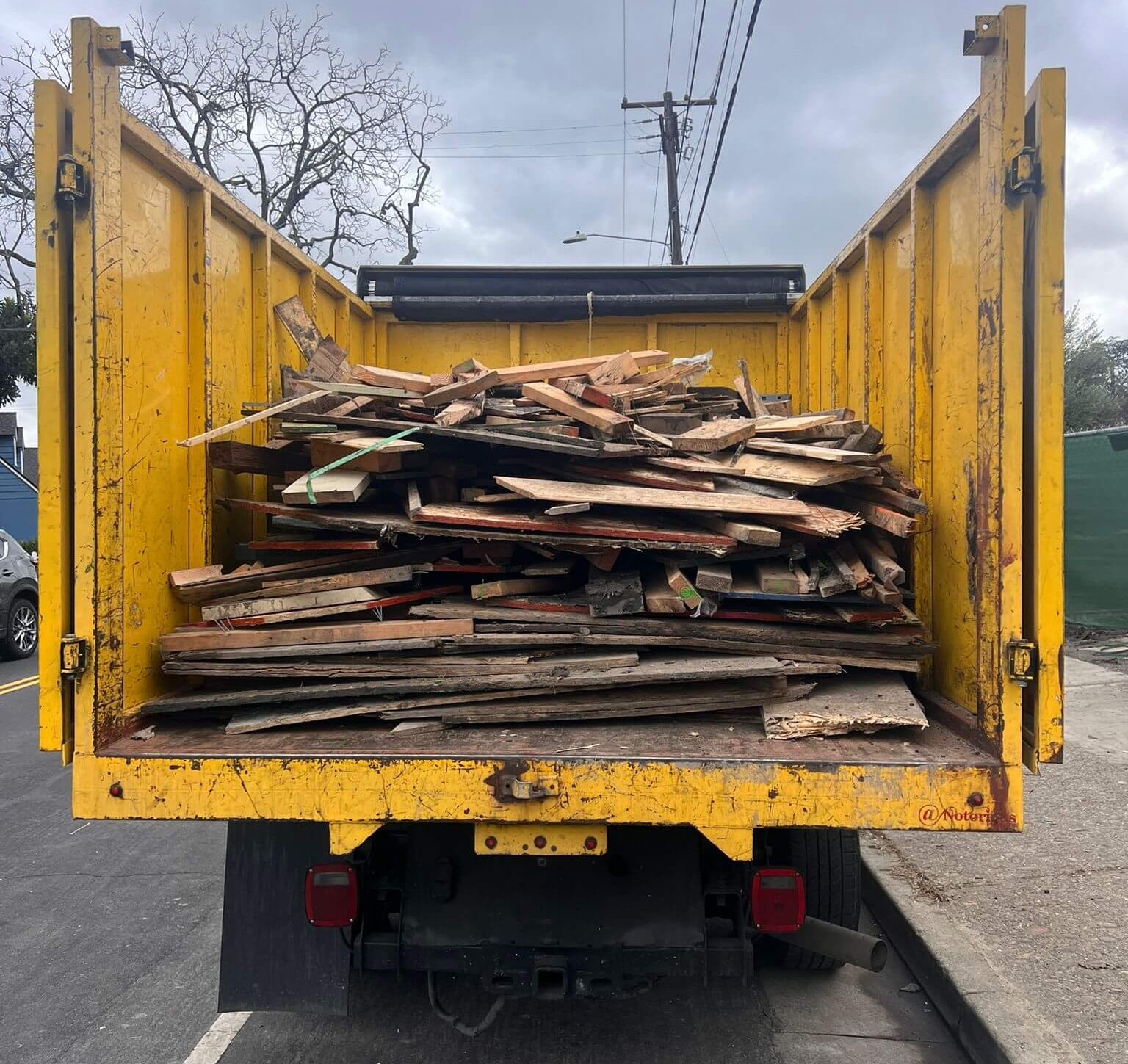
On a remodel, debris is a scheduling problem before it is a disposal problem. The tile has to be out before the floor goes down. The demo waste has to be gone before the framer can work. The pile in the driveway has to disappear before the client comes to look at progress.
This guide covers how construction debris removal works on a Campbell job site: when to clear as you go, what the crew needs on arrival, what gets hauled and what does not, and how to fit collections around the trades.
Key Takeaways
- Most remodel debris is straightforward. The two things that complicate a job are weight and asbestos.
- Clearing as you go keeps a site workable. One clearance at the end is cheaper per load but needs somewhere to stack debris in the meantime.
- Concrete, tile and masonry hit a weight limit long before they fill a truck, so they are quoted differently.
- Asbestos and lead paint debris cannot be hauled by a junk removal crew. On a pre-1980 property, test before demo rather than after.
- Tell us the window between trades when you book. Scheduling around it is usually possible if it is known in advance.
The Short Answer
Construction debris is priced on volume, the same as anything else, with one exception. Dense material such as concrete, tile, brick and plaster reaches a vehicle’s weight limit well before it fills the space, so those loads are sized by weight instead.
You get a firm price before anything is loaded, covering the labor, the loading, the haul and the disposal. On an active site that price is usually given from photographs rather than a visit, because a visit costs you a day you do not have.
For more information about pricing, see our guide to waste clearance costs.
Clearing as You Go, or One Clearance at the End
This is the first scheduling decision and it is worth making deliberately rather than by default.
| Clearing as You Go | One Clearance at the End | |
|---|---|---|
| Suits | Long projects, occupied homes, tight sites with nowhere to stack debris safely. | Short projects, sites with yard or driveway space, trades finishing close together. |
| Advantage | The site stays safe and workable. The next trade is not working around a pile. | One visit, one quote, less coordination for you. |
| Cost shape | Several smaller collections. More total visits. | Fewer, larger loads. Usually lower per unit of volume. |
| Watch for | Calling for small amounts. Group collections rather than clearing after every task. | The pile is always larger than estimated by the end. Photograph it as it grows. |
The practical middle ground on most remodels: clear after demolition, clear after the rough-in trades, and clear at the end. Three collections rather than seven, and the site never gets to the point where debris is in the way.
Working Around the Trades
This is the part that separates a hauler who has worked construction from one who has not.
- Tell us the window. If the tile crew leaves Thursday afternoon and the floor goes down Monday morning, say so. A collection booked into that gap costs nothing extra and saves a day.
- Demolition debris first. It is the largest volume and the most disruptive to work around. Clearing it promptly changes how the rest of the project runs.
- Keep a staging area. One place debris accumulates, as close to vehicle access as the site allows. It makes every collection faster and cheaper.
- Flag occupied homes. If the client is living there, the route matters. Floor protection and a planned path through the house are part of the job rather than an afterthought.
- Give notice where you can. Same day is often possible, but a day’s notice gets you a better window and a crew sized for the load.
What Gets Hauled from a Job Site
If it came out of the building and it is not on the exclusion list below, it goes.
| Material | What This Covers |
|---|---|
| Demolition debris | Mixed waste from a strip-out, including plaster, lath, framing offcuts and broken fixtures. |
| Drywall | Sheets, offcuts and broken board. |
| Lumber and framing | Offcuts, plywood, trim, baseboards, subfloor, old decking and fencing. |
| Flooring | Carpet, underlay, laminate, vinyl, engineered wood, tack strip and tile. |
| Cabinets and countertops | Kitchen and bathroom cabinetry, laminate and stone tops, vanities. |
| Windows, doors and glass | Frames, sashes, glazed units, interior and exterior doors. |
| Roofing | Shingles and felt, usually bagged. See the weight note below. |
| Metal | Ducting, conduit, pipework, rebar offcuts, old fixtures. |
| Concrete and masonry | Concrete, brick, block, stone. Weight limited rather than volume limited. |
| Site waste | Packaging, pallets, protective sheeting, empty buckets and offcut bags. |
The Weight Problem
The most common surprise on a construction job, and the easiest one to plan around.
Most debris runs out of truck space before it runs out of weight allowance. Concrete, tile, brick, mortar, plaster and soil do the opposite. A pile that looks modest can exceed what a vehicle is legally permitted to carry, which turns what looked like one load into two or three.
When you book, quantify the heavy material rather than describing it. Square footage of tile, a rough count of concrete sections, the dimensions of a slab. That way the right vehicle arrives and the quote reflects the real number of trips.
What Cannot Be Hauled
Asbestos, and Anything Suspected of Containing It
Asbestos was used widely in residential construction until it was phased out through the 1970s. It appears in older popcorn ceilings, floor tile and the adhesive beneath it, pipe lagging, and some siding and roofing. In California, asbestos abatement is licensed, regulated work, and a junk removal crew is not an abatement contractor.
On any property built before about 1980 where ceilings, flooring or siding are being disturbed, test before demolition rather than after. If something suspect appears mid-project, stop and have it identified. We will not load material we suspect contains asbestos.
Lead Paint Debris
Lead-based paint was banned for residential use in the United States in 1978. Debris from sanding, scraping or stripping painted surfaces in an older property needs handling under lead-safe rules rather than going into a general load.
Liquids and Chemicals
Paint, thinners, solvents, adhesives, sealants, fuel and motor oil cannot be loaded. Empty, fully dried containers are generally fine. Liquid is not.
Treated and Painted Lumber, Sometimes
Pressure-treated lumber and heavily painted wood carry disposal restrictions that vary by facility. Flag it if a load is mostly treated decking or painted trim, so it goes to the right place.
What the Crew Needs on Arrival
Four things, and getting them right takes time off the job.
- Somewhere to park. As close to the debris as the site allows. On a tight street, say so in advance.
- A clear route. From the staging area to the vehicle, without weaving through materials or other trades.
- Someone who can approve the price. Either on site, or agreed in advance from photographs. A crew waiting for a callback is time you are paying for.
- A clear line on what is going. Materials being reused look a lot like debris to someone who was not there when the decision was made. Separate or mark anything staying.
What About a Dumpster?
It is a fair question and the answer depends mostly on who is loading. A container suits long projects where debris accumulates gradually and you have the space and the labor. A crew suits a pile that already exists and work you would rather not pay your own trades to do.
We covered the full comparison separately, including permits, weight allowances and the costs people miss on both sides. See our guide to junk removal vs. dumpster rental in Campbell.
How to Get an Accurate Quote
- Photograph the pile from a few steps back, with something in shot for scale.
- Say what the material is. Mixed remodel debris prices differently from a load that is mostly concrete.
- Quantify anything heavy separately. Tile, concrete, brick, plaster.
- Say where it is. Curb, driveway, back yard, or still inside on an upper floor.
- Flag the property age if it is pre-1980 and ceilings, flooring or siding are being disturbed.
- Give the window between trades if there is one.
Frequently Asked Questions
Can you come while the job is still running?
Yes, and on longer projects that is usually the better approach. Tell us the window between trades when you book and we will work to it where the schedule allows.
Will you take concrete and tile?
Yes, but these are weight limited rather than volume limited. A small pile of concrete can be a full load by weight. Give us a rough quantity when you call so the right vehicle arrives and the quote covers the real number of trips.
Do we need to bag everything?
No, but bagging small, loose or dusty material speeds the load up considerably. Bulky items such as cabinets, doors and lumber do not need bagging. Avoid filling bags with tile or concrete, because they split.
What happens if asbestos turns up mid-job?
Work stops on that material and it needs identifying before anything else happens. Asbestos abatement is licensed, regulated work in California and is not something a junk removal crew can handle. On a pre-1980 property, testing before demolition avoids this entirely.
Can you work on an occupied home?
Yes, and it is common on remodels. Tell us when you book so the crew brings floor protection and plans a route through the house rather than improvising one.
How much notice do you need?
Same day is often possible for a straightforward load. A day’s notice gets you a better window and a crew sized for the job, which matters more on a site with a tight schedule.
Clearing a Site in Campbell
The Top Junk clears construction and remodel debris from job sites across Campbell and the South Bay. We work around the trades, protect the route on occupied homes, and leave the work zone clear for whoever is in next.
Send a photo of the pile, say what the material is and give us the window you are working to. Call or text (669) 327-6688, or see our construction debris removal service for what the job covers.